AERO VINTAGE BOOKS
2017 B-25 NEWS
B-25 News Archive
B-25 News
2016 B-25 News
2015 B-25 News
2014 B-25 News
2013 B-25 News
2012 B-25 News
2011 B-25 News
2010 B-25 News
2009 B-25 News
2008 B-25 News
2007 B-25 News
2006 B-25 News
2005 B-25 News
2004 B-25 News
1999-2003 B-25 News
Back to B-25 InformationBack to the Main Page
We're including these pages as an update point for B-25 news. We'll post information garnered from any variety of sources, and notate that source at the end of the item. If anyone has anything they'd like to add, please let us know.
November 2017
- Aero Trader Hits Another Line Drive: That's a nod to the World Series, etc, but I'm referring to the static B-25J put together by the guys at Chino for a Russian museum. It is well documented in the December 2017 issue of Warbirds International in an article by Michael O'Leary. This takes the remanants of a couple less-than-airworthy B-25s and melds them into a fine static display. The contributing airframes were TB-25J 44-31504 (N9753Z), which provided the cockpit and center section, associated parts for the tail coming from B-25J 44-31104 (N39E) and B-25J 45-8882 (N32T ), and the center section coming from one unidentfied center section of a B-25 recovered years ago from a pit at the Porterville, California, airport. You'll have to get a copy of the Warbirds International issue to see some great photos of the airplane.
The article does not name the new museum in Russia that is destined to receive the B-25. Evidently more informaiton is forthcoming, but the B-25 will shortly be on its way for eventual display.
Kudos to Carl Scholl and Tony Ritzman and their guys at Aero Trader for putting together a nice static display airplane out of stored and non-airworthy parts drawn from their own extensive stocks.
And, I'll thank Coert Munk for letting me know about this early on.
- EAA B-25 Fundraising Drive: A funding drive is underway to aid in the restoration of the EAA B-25H, 43-4432 (N10V) back to airworthy condition.

Though the work has been underway for more than a year, the fundraising effort was put into high gear at AirVenture at Oshkosh this past July. The goal is to raise $400,000 which will go towards:
More information can be found on the EAA website, specifically located right here.- Overhaul existing engines, propellers and acquire a back-up engine
- Repair hydraulic systems
- Install new brakes and wheels
- Install new avionics and engine instruments
- Interior and exterior painting
- Install new seating and passenger safety equipment
This airplane, by the way, was featured as two different airplanes in the film Catch-22: it flew as Berlin Express in combat colors, and also flew as the spruced up VIP B-25 that arrived with General Dreedle (Orson Welles), the B-25 complete with white sidewall tires.
EAA would like to get the airplane back in the air in the spring of 2018. (One hopes they stop showing it as B-25J.)
- B-25 Books Now Available at Amazon: Author Wim Nijenhuis let me know that his two somewhat-hard-to-get B-25 books are now available on Amazon.com. The two books are Mitchell Masterpieces Vol 1 and B-25 Factory Times.
Mitchell Masterpieces Vol. 1 was released last year and is a reported to be a great new book about the paint schemes and markings of B-25 Mitchells in U.S. service. It is a voluminous book containing 248 pages and about 900 illustratons. B-25 Factory Times, published in 2013, documents the production of B-25s by North American at its various plants. Both books have been a bit hard to get on this side of the Atlantic due to its publication in the Netherlands. Globalization has not yet reached postage rates for shipping books overseas.

Wim also notes that Mitchell Masterpieces Volume 2 (covering foreign service) will be expected at the end of 2018.
April 2017
- 75th Anniversary of the April 1942 Doolittle Tokyo Raid: No real updates here for the event to be held over the weekend from Friday, April 15, through Tuesday, April 18. The sponsor of the pre-gathering to the held at the Grimes airport at Champaign, Ohio, is still expecting fifteen to seventeen B-25s. Not sure how many of those are actually confirmed and how many are 'hoped for.' We'll see soon enough, but if weather permits, there will B-25 flying both at Grimes and at the NMUSAF museum site at Wright Field near Dayton.
- CAF PBJ-1J at Alameda, CA: Roger Cain sent in this nice view of recently restored B-25J 44-30988 (N5865V) which is, technically, the only surviving PBJ, that being PBJ-1J BuNo 35857.

The PBJ was made several low passes over the ex-naval air station at Alameda that commemorated the loading of sixteen B-25’s onto the USS Hornet (CV-8), at NAS Alameda, 75 years earlier to the date, April 1.
- War Memorial B-25, circa 1972: Nick Veronico sent me this nice photo of TB-25N 44-29825 taken in November 1972 when it was being used as a war memorial at the Forest Lawn Garden cemetary near Pittsburgh, Pennsylvania.
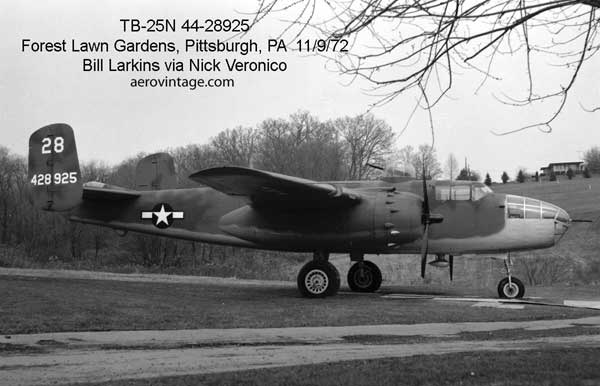
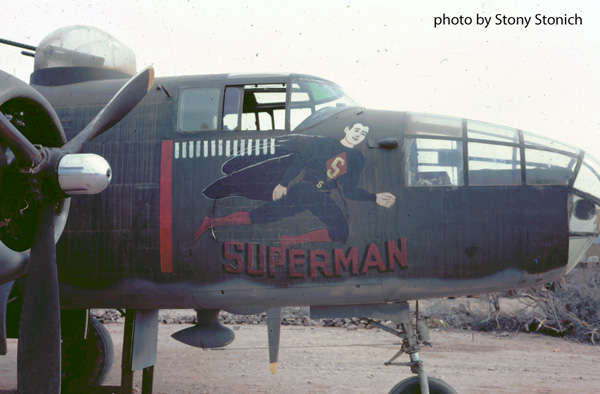
This B-25 had flown in the film Catch-22 as Superman and, after the filming was completed in 1969, languished on the Tallmantz lot at Orange County Airport in deep storage. It was sold for $6,000 (things were different then) to the cemetary for use as the war mermorial and ferried from KSNA to Washington County Airport near Pittsburgh in May 1971 by Tallmanz chief pilot Frank Pine. It was airlifted via helicopter to the cemetary in October 1972, so this photo shows the airplane shortly after it went on display. It remained at the cemetary until 1984 when Harry Doan purchased it. In 1992 it went to the Cavanaugh Flight Museum and subjected to an exacting restoration back to a combat configuration by Aero Trader at Chino.
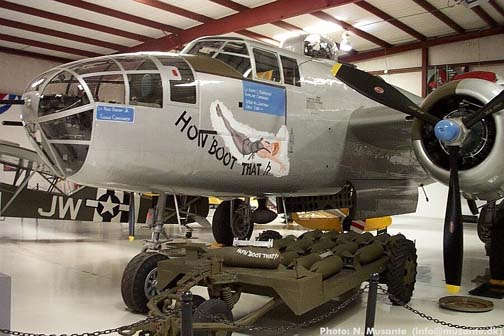
Notable about this B-25 was that it has a confirmed combat history while flying with the 310th BG, Twelfth Air Force from Italy in late 1944 and early 1945. It had flown as How 'Boot That!? during its combat time and was restored back to that paint scheme. The airplane is currently on display with the Cavanaugh collection but is not flown.
Seen here is the same B-25 while on location in Mexico during the filming of Catch-22
And how it looks these days...


February 2017
- 75th Anniversary of the April 1942 Doolittle Tokyo Raid: Efforts are coming together for a gathering of B-25s to help commemorate the April 1942 raid on Tokyo led by Lt. Col. Jimmy Doolittle. For B-25 specifics, a good number of B-25s, possibly up to sixteen, are slated to attend a four day series of events beginning on Saturday, April 15, at the Grimes Urbana airport in Champaign, Ohio, and continuing the following day. On Monday, April 17, the B-25s are scheduled to fly to Wright Field (landing on a usually closed runway) for display at the NMUSAF. Commemoration events and B-25 flyovers will take place at the NMUSAF on the actual anniversary of the raid, on Tuesday, April 18.
The Champaign Aviation Museum is hosting the weekend event, and B-25 flight experiences will be available for those interested on both Saturday and Sunday. Check out the museum's website.

The NMUSAF commemoration includes the participation Doolittle's copilot, Lt. Col. Richard “Dick” E. Cole. Of the eighty crewmembers (five per B-25) who crewed the sixteen B-25s, Cole is the sole remaining surviving crewmember and is 101 years old. The NMUSAF website notes the plans for the "...anniversary events on April 17-18 are still being finalized but plans include the return of several B-25 Mitchell bombers landing on the runway behind the museum and being placed on static display; a memorial service and B-25 flyover (weather permitting)." Also, the Air Force Museum Theatre is planning a living history event with films on the Doolittle Raid and the Air Force Museum Store will have commemorative merchandise available to purchase.
As noted above, the Champaign folks are expecting sixteen B-25s, the NMUSAF "several." Some other sources are showing six or seven somewhat firm committments, firm being a relaitive term when speaking of seventy year old airplanes. Regardless, it should be a significant event.
- B-25 Under Rebuild in Australia: Recently posted on its Facebook Page was an update on the static restoration of TB-25K 44-31508 (N6578D) underway in Adelaide, Australia. B-25 guys may remember this airframe as Lucky Lady, and as the one that sat, basically derelict, at the Franklin, Virginia, airport for a decade or two due to a complicated legal ownership issue. The paperwork was straightened out in 2015 by Reevers Warbirds (and Pastoral Services), an little-bit mysterious Australian company reportedly a husband and wife team of aircraft collectors and cattle breeders. The B-25 was disassembled in Virginia and shipped to Australia where it was stored through a good part of 2016. Now, however, efforts are well underway to reassemble the B-25 and repaint it in the colors worn by the Netherlands Eastern Indies Air Force while operated by the Dutch 18 Squadron. The effort is facing a bit of a deadline as the aircraft is to be unveiled at an April 7, 2017, event to be attended by veterans and their families, with a public unveiling the following day. As can be seen on the group's Facebook page, progress is obvious.


If things move right along, it would appear the airplane may be shown in April externally complete and painted, though the interior has much work remaining as it is basically gutted. Nice to see an airplane on the brink of being scrapped receiving such attention.
- EAA B-25H Undergoing Work: Not real new news, but seen at Oshkosh in July 2016 was the EAA B-25H, 43-4432 (N10V), drawing some attention as the focus of getting it back into the air. It was on public display near the flight line wearing it's Catch-22 moniker, that being Berlin Express. It is undergoing some heavy maintenance and will be, apparently, repainted in these markings. It has not been flown for a decade or more so it will be nice to see it back in the air again.

And here is a view in its movie guise, circa 1969, when it was on the set of the motion picture filming in Guaymas, Mexico.

For those interested, this is drawn from B-25 Mitchell in Civil Service: 43-4432 was built as B-25H-5-NA and delivered on Feb. 4, 1944. Initial assignment was to Lowry Field, Colorado, arriving in late March 1944. After its military service, it was deemed excess to needs and transferred to the RFC at Altus, Oklahoma, in November 1945. Sold on June 25, 1947 to Joe Zeppa, Delta Drilling Company, Dallas, TX for $758.33. It went through a number of civil owners and received an plush executive conversion in the 1950s and flown by Husky Oil Company. Several other owners though the late 1960s when it was obtained for the movie work (one of 18 B-25s obtained for Catch-22. After the film it was sold to Dr. William S. Cooper, who later donated it to the EAA.
Long time since the last update and, sadly, there's not all that much that I have noted going on in the B-25 world. However, a few items of interest....
B-25 News Archive
B-25 News
2016 B-25 News
2015 B-25 News
2014 B-25 News
2013 B-25 News
2012 B-25 News
2011 B-25 News
2010 B-25 News
2009 B-25 News
2008 B-25 News
2007 B-25 News
2006 B-25 News
2005 B-25 News
2004 B-25 News
1999-2003 B-25 News
Back to B-25 InformationBack to the Main Page